The computer monitoring software market in 2026 consists of five distinct categories of tools, each solving its own specific problem. The mistake most managers make is comparing products from different categories as though they are interchangeable. The reality: you need to understand your goal first, then choose a category, and only then select a specific product.
In this article we’ll break down the 5 key categories of computer monitoring software: automatic time trackers, distraction blockers, productivity monitoring systems, cybersecurity tools, and analytics platforms. How to choose the right category for your needs — and why “spyware-style” monitoring that treats employees like teenagers is destructive. Drawing on Clear, Newport, and Covey.
First principle: monitoring software is not a single category
Before choosing a specific product, it’s important to grasp one philosophical point: what’s currently preventing you from making a good choice is the perception of “computer monitoring software” as a homogeneous category. It isn’t. Fundamentally different tools solve fundamentally different problems.
Imagine asking “what’s the best car?” Without context, the question is meaningless. A sedan for the family? A pickup for construction? A sports car for the track? An electric vehicle for the city? The same applies to computer monitoring software: there is no “best” — only the best one for your specific situation.
5 categories of computer monitoring software, each solving a different problem:
- Automatic time trackers — for time accounting and productivity
- Distraction blockers — for self-discipline and focus
- Productivity monitoring systems — for management analytics
- Cybersecurity and DLP tools — for data protection
- HR analytics platforms — for team evaluation and development
Before reading further, answer these 3 key questions:
| Question | Your answer |
|---|---|
| Who is the primary user — the employee or the manager? | |
| What do you want to measure or control? | |
| Is this for an individual or a team? |
Now each category can be examined through these questions.
Category 1: Automatic time trackers
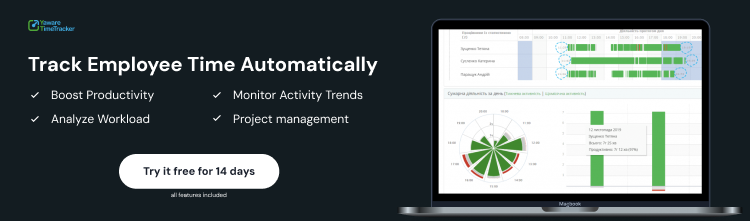
Typical examples: Yaware TimeTracker, RescueTime, Toggl Track, Harvest, Clockify.
What they do: Run silently in the background, recording time spent in different applications and on websites. They automatically categorize activity as “productive” or “unproductive” (often with customizable rules).
How they work: An agent application is installed on the work PC, launches at login, and runs invisibly. Data syncs to the cloud and is accessible through a dashboard.
Strengths:
- Zero friction: the employee does nothing — data is collected automatically
- An objective picture of the day: where time actually goes
- Productivity trends over weeks and months
- Identification of “silent time sinks”
- Legally compliant when implemented correctly
Weaknesses:
- Do not block distractions — only record them
- Do not show the content of work (only which apps were used)
- Can cause pushback from the team if communicated poorly
Who critically needs this:
- Teams that need to understand where their time disappears
- Service businesses that bill by the hour
- Remote teams that need non-intrusive time accounting
- Individuals looking to self-diagnose their productivity
Drucker’s principle in action: “The first step toward effectiveness is recording actual time use in real time.” Automatic time trackers are the literal implementation of that recommendation.
| Parameter | Automatic time trackers |
|---|---|
| Complexity | Low |
| Friction for employee | 0% |
| Data accuracy | 95–99% |
| Price/month/user | $5–15 |
| Team size | 1–500+ |
→ More on automatic trackers in the article Automatic time tracking: moving away from manual logging
Category 2: Distraction blockers
Typical examples: Freedom, Cold Turkey, StayFocusd, RescueTime Focus, Forest.
What they do: Temporarily block access to specified websites and applications on a schedule or at the user’s request. They protect focus during deep work sessions.
How they work: The user creates a list of “focus-dangerous” sites (social media, news, YouTube), sets a blocking schedule or starts a session manually. During a block, those sites are physically inaccessible.
Strengths:
- Actually protect focus — make distraction impossible
- Compensate for weak willpower through environmental design
- Ideal for self-discipline
- Free or very inexpensive
Weaknesses:
- Provide no analytics — only block
- Only work when the user voluntarily installs them
- Can technically be circumvented (though most users don’t bother)
- Not designed for team management
Who critically needs this:
- Individuals who struggle with concentration
- Creative professionals who need long deep work sessions
- Students, freelancers, and remote workers
- Anyone using them alongside an automatic time tracker
Clear’s principle from Atomic Habits: “The best way to break a bad habit is to make it impractical to do.” Distraction blockers are the literal embodiment of that principle.
| Parameter | Distraction blockers |
|---|---|
| Complexity | Very low |
| Friction for employee | Low (voluntary) |
| Management value | Low |
| Price/month/user | $0–10 |
| Team size | 1 (individual use) |
Important: distraction blockers are a tool for individual discipline, not corporate control. Imposing them on a team leads to resistance and workarounds. The best approach is to recommend, not mandate.
Category 3: Productivity monitoring systems
Typical examples: Yaware (with monitoring module), Hubstaff, Time Doctor, Teramind (enterprise level), ActivTrak.
What they do: Record employee activity at a deeper level: applications, websites, optional screenshots, mouse and keyboard activity, and session duration.
How they work: An extended version of automatic time trackers, with optional additional monitoring features: periodic screenshots, activity analysis, idle time detection, and automatic productive/unproductive categorization.
Strengths:
- Deeper analytics than basic trackers
- Anomaly detection (sudden idle periods, atypical activity)
- Client billing with verified work time documentation
- Support for remote work with an audit trail
Weaknesses:
- Can become “spyware” if implemented incorrectly
- Risk of the “treating employees like teenagers” syndrome
- Legal nuances, especially around screenshots
- Team resistance if communication is poor
Who critically needs this:
- BPO and outsourcing companies that bill by the hour
- Businesses with high trust-abuse risk (finance, legal)
- Companies that have experienced a data breach
- Only when there is a genuine need — not “just in case”
The authors of Rework put it best: “If you treat your employees like teenagers, you’ll get teenage-quality work.” Productivity monitoring systems sit in this grey zone. Used correctly they provide objective management data. Used incorrectly they create a culture of distrust.
| Parameter | Productivity monitoring systems |
|---|---|
| Complexity | Medium |
| Friction for employee | Medium (psychological) |
| Management value | High |
| Price/month/user | $10–25 |
| Team size | 5–500 |
Category 4: Cybersecurity and DLP tools
Typical examples: Symantec DLP, Microsoft Purview, Forcepoint DLP, ObserveIT, Code42.
What they do: Protect corporate data from leaks. They monitor the movement of sensitive information, block unauthorized transfers, and log attempted breaches.
How they work: Deep integration with the corporate network and employee PCs. Files are scanned against classifiers (personal data, financial information, trade secrets). Transfers through unauthorized channels — personal email, USB drives, consumer cloud storage — are blocked.
Strengths:
- Actually prevent data leaks
- Legally required for companies handling personal client data
- Integration with existing corporate infrastructure
- Detection of Shadow IT
Weaknesses:
- High cost for serious solutions
- Complex deployment (takes months)
- Requires dedicated cybersecurity staff
- Provides no productivity analytics
Who critically needs this:
- Financial institutions (banks, fintech)
- Healthcare organizations (patient personal data)
- Companies with critically important trade secrets
- Large enterprises following a cybersecurity incident
- Companies subject to strict data protection regulations
| Parameter | DLP / Cybersecurity |
|---|---|
| Complexity | Very high |
| Friction for employee | Noticeable |
| Management value | Specialized |
| Price/month/user | $30–150+ |
| Team size | 100+ |
→ More on data protection in the article Computer monitoring software: protecting against Shadow IT
Category 5: HR analytics platforms
Typical examples: Visier, Microsoft Workplace Analytics (Viva Insights), Humanyze, ActivTrak Insights.
What they do: Rather than merely collecting data, they transform it into HR intelligence: burnout risks, engagement trends, team effectiveness, and optimization recommendations.
How they work: Data is aggregated from multiple sources — time trackers, calendars, email, and chat — and surfaced as HR insights: “Elena is in the burnout risk zone,” “Team X has 40% less collaboration than a comparable team,” “A week without deep work is a crisis indicator.”
Strengths:
- Strategic level of analysis
- Risk forecasting (burnout, attrition)
- Data-backed HR decision-making
- Objective data for evaluating managers
Weaknesses:
- Very high cost
- Require a mature HR function
- Complex deployment (3–6 months)
- ROI not justified for small companies
Who critically needs this:
- Corporations with 500+ employees
- Mature HR departments with an analytics focus
- Companies with high hiring costs and turnover
- Businesses where the team is the primary asset
| Parameter | HR analytics platforms |
|---|---|
| Complexity | Highest |
| Friction for employee | Low (data aggregation) |
| Strategic value | Highest |
| Price/month/user | $30–80+ |
| Team size | 200–10,000+ |
How to choose the right category: a decision matrix
Now that you know all 5 categories, here is a practical framework for making your choice. Identify your goal — and find the recommended category.
| Your goal | Recommended category |
|---|---|
| Understand where the team’s time goes | 1: Automatic time trackers |
| Protect your own concentration | 2: Distraction blockers |
| Manage team productivity | 1 + optionally 3 |
| Bill clients by the hour | 1 or 3 |
| Protect sensitive data | 4: DLP / Cybersecurity |
| Detect Shadow IT | 1 (advanced) or 4 |
| Strategic HR analytics | 5: HR platforms |
| Identify burnout risks | 1 or 5 |
| Investigate an incident | 3 + 4 |
| Individual self-diagnosis | 1 + 2 (individually) |
- Rule 1: Start with Category 1. An automatic time tracker is your foundation. Without it, every other tool operates without a complete picture.
- Rule 2: Add Category 2 optionally. Blockers are an individual choice. Recommend them — don’t mandate them.
- Rule 3: Category 3 is targeted. Extended monitoring is only for specific roles with a justified reason — not for the entire team “just in case.”
- Rule 4: Category 4 is driven by legal or business necessity. Deploy DLP when you genuinely handle critical data — not because it sounds impressive.
- Rule 5: Category 5 is for mature enterprises. HR analytics is a serious investment that only pays off at scale.
Conclusions
The computer monitoring software market comprises 5 fundamentally different categories of tools, each solving its own problem. Instead of randomly searching for the “best product,” first understand your goal, choose a category, and only then select a specific product within it. The biggest mistake is treating heavy-handed surveillance as a normal implementation approach. The greatest wisdom is using each category for its intended purpose and not mixing their roles.
Key takeaways from this article
- 5 categories: trackers, blockers, monitoring, DLP, HR analytics
- Automatic time trackers are the foundation — everything starts here
- Blockers are an individual choice, not a team mandate
- Monitoring systems are targeted — for specific roles only
- DLP is deployed out of genuine necessity, not “just in case”
- HR platforms are for mature enterprises of 200+
- Mature teams use 2–3 categories, not one “all-encompassing” solution
FAQ
Can one program cover all 5 categories?
Technically, multipurpose platforms exist. In practice, they tend to be weak in each individual category. It’s the “Swiss Army knife” problem versus using specialized tools. For serious use cases, 2–3 specialized products will always outperform one mediocre all-rounder. The exception is very small teams (under 10 people), where simplicity may outweigh depth.
Where should you start if you’ve never used computer monitoring software?
With Category 1 — automatic time trackers. This is the foundational layer that delivers the most insight for the least cost and risk. Try Yaware or Toggl for 2–3 weeks and see whether you need more. In 70% of cases, Category 1 is all you’ll ever need.
How do you avoid the “treating employees like teenagers” trap when implementing monitoring software?
Three key rules: (1) Transparency — the team knows what data is collected and why; (2) Access — employees can see their own data; (3) Proportionality — the level of monitoring matches real risks, not the manager’s anxieties. A basic time tracker for everyone. Deeper monitoring only when there is a justified reason for specific roles. DLP where sensitive data is actually present. Not “one mode for all.”