
Imagine being able to “rewind” a workday like a video — and see exactly what happened. Not based on a retelling (“well, I was working”), not from memory (which distorts everything), but objectively: which application, how many minutes, in what sequence. That is precisely what computer activity recording software does — it transforms an invisible, traceless workday into a visible timeline that can be reviewed at any time.
In this article, we will look at how computer activity recording software builds a workday timeline, why the ability to “rewind” activity matters, and where the line falls between useful recording and invasion of privacy. With compliance with Ukrainian labour law.
The Problem: the Workday Disappears Without a Trace
Here is an uncomfortable truth: an ordinary workday leaves no trace. It simply vanishes. By the end of the day, neither the employee nor the manager can say with certainty what actually happened.
Try right now to recall what you were doing on a Tuesday at work two weeks ago. You cannot. And that is normal — human memory is not designed to record time.
What happens without activity recording:
- Disputes over “who did what” are settled by emotions, not facts
- There is no way to recover where project time was lost
- Client disagreements become “your word against mine”
- Mistakes repeat because there is no analysis of what went wrong
Peter Drucker put it concisely in The Effective Executive: human memory is an unreliable witness to one's own time. We genuinely believe we remember our day — and we are genuinely wrong. Computer activity recording software replaces that unreliable recollection with an accurate record.
What Is a Workday Timeline
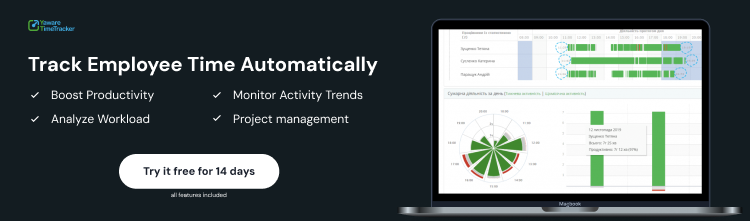
The core of computer activity recording software is the activity timeline — a sequential log of everything that happened on the computer, anchored to real clock time.
What a timeline looks like:
| Time | Activity | Duration |
|---|---|---|
| 9:02 | Outlook (email) | 18 min |
| 9:20 | Jira (ticket #432) | 12 min |
| 9:32 | VS Code (development) | 1 hr 47 min |
| 11:19 | Break | 14 min |
| 11:33 | VS Code (continued) | 52 min |
| 12:25 | Lunch | 48 min |
This is not “screenshots every second” and not “screen recording.” It is a structured log: which application was active, when, and for how long. Enough to reconstruct the picture of a day — without intruding into the content.
The key capability — “rewind” any moment:
- Any day from last week — to see what was being worked on
- A specific hour — to investigate an incident
- A project period — to understand where the time went
→ On the structure of the workday — in the article Workday Time Tracking: Where Your Working Hours Actually Go
Why “Rewind”: 4 Real-World Scenarios
Activity recording is not valuable in itself — it becomes valuable when you need to restore the past. Here are 4 common situations where computer activity recording software comes to the rescue:
Scenario 1 — Client dispute. The client says “nobody worked on my project.” You rewind the timeline and show the actual hours logged. The conflict is settled with facts.
Scenario 2 — “Where did the week go.” A project ran over schedule for no obvious reason. You rewind — and see that 40% of the time went to endless revisions, approvals, and context-switching. You find the real cause.
Scenario 3 — Incident investigation. Something went wrong (an error, a missed deadline). Instead of “who is to blame” — an objective review of what happened and when. Lessons learned for the future.
Scenario 4 — Employment dispute. An employee claims they were overworked. Or the opposite — an accusation of non-performance. The timeline provides an objective picture for resolution.
| Scenario | Without activity recording | With activity recording software |
|---|---|---|
| Client dispute | Emotions, lost client | Timeline = facts |
| “Where did the time go” | Guesswork | Exact cause |
| Incident investigation | Looking for someone to blame | Objective analysis |
| Employment dispute | Word against word | Timestamped data |
Where the Line Falls: Activity Recording ≠ Total Surveillance
This is a critically important point. Computer activity recording software does not mean recording every second of the screen or every keystroke. There is a clear boundary between useful recording and illegal surveillance.
What a proper computer activity recording tool records:
- ✅ Which application or website is active
- ✅ Time and duration
- ✅ Sequence (timeline)
- ✅ Activity category
What it must NOT record:
- ❌ Content of correspondence (violation of Art. 31 of the Constitution)
- ❌ Keystrokes / passwords (keylogger — Art. 163 of the Criminal Code)
- ❌ Continuous screen video recording
- ❌ Personal data outside a work context
| Parameter | Useful recording | Illegal surveillance |
|---|---|---|
| Object | Metadata (application, time) | Content (text, passwords) |
| Legality | ✅ Legal with consent | ❌ Art. 163 CC, Art. 31 Constitution |
| Purpose | Reconstruct the picture of a day | Total surveillance |
| Impact on trust | Acceptable | Destructive |
The principle is simple: activity recording answers the question “when and what were you working on,” not “what exactly did you write or read.” The first is legal and useful. The second is illegal and destructive.
→ On the limits of monitoring — in the article Computer Monitoring: What It Is, Types, and How It Works
How to Read a Timeline: From Data to Insights
The recording alone is just data. The value appears when you know how to read the timeline and extract insights. Here is what to look for:
1. Continuous blocks vs. fragmentation
Long blocks in a single application signal deep work. Chaotic switching every few minutes signals fragmentation — a concentration problem.
2. When productive work actually begins
Timelines often reveal that the first hour of the day is a “warm-up” (email, news, chat), and real work starts later. A useful insight for scheduling.
3. Time thieves
Which activities quietly eat up hours. Often it is not the obvious culprits like social media, but endless small communications and context-switches.
4. Productivity patterns
When a person is most productive (morning vs. after lunch), and whether their schedule reflects that.
| What to look for in the timeline | What insight it provides |
|---|---|
| Block length | Capacity for concentration |
| Start of real work | How long the “warm-up” lasts |
| Hidden time thieves | Where time leaks unnoticed |
| Peak hours | When to schedule complex tasks |
→ On reading activity data — in the article Work Time Tracking Software: Where Your Day Actually Lives
The Legal Side: How to Record Lawfully
Computer activity recording software processes personal data, so it must comply with Ukrainian legislation. The good news: done correctly, this is straightforward.
What is required for lawful recording:
- A company order introducing the system
- Inclusion in the internal labour regulations (Art. 142 of the Labour Code)
- Written consent from employees (Art. 6 of the Law on Personal Data Protection)
- Transparency — employees know recording is in place
- Content boundary — metadata is recorded, not content (Art. 31 of the Constitution)
| Legal requirement | How to fulfil it |
|---|---|
| Time tracking (Art. 30 Labour Code) | Activity recording provides it |
| Internal regulations (Art. 142 Labour Code) | Formalise the system |
| Consent (Law on Personal Data Protection) | Written consent at rollout |
| Confidentiality of correspondence (Art. 31) | Metadata yes, content no |
An added bonus: the recorded timeline becomes evidence in employment disputes. Article 235 of the Labour Code places the burden of proof on the employer — an objective activity record provides that proof.
→ On the legal weight of data — in the article Timetracker: Protection Against Labour Inspectorate Fines and Employment Disputes
Conclusions
Computer activity recording software turns a traceless workday into a visible timeline that can be “rewound” at any time. It saves you in client disputes, helps you find where time went, provides a basis for incident investigations, and protects you in employment disputes. The key boundary: activity recording captures metadata (application, time), not content — that is the difference between a legal tool and illegal surveillance.
Key takeaways from this article:
- The workday disappears without a trace; memory is an unreliable witness (Drucker)
- The timeline = a “black box”: any moment can be rewound
- 4 scenarios: client dispute, “where did the time go,” incident investigation, employment dispute
- The line: recording metadata (legal) ≠ recording content (Art. 163 CC, Art. 31)
- Reading the timeline: blocks, warm-up, time thieves, peak hours
- Recording = evidence in disputes (Art. 235 Labour Code) when properly documented
FAQ
Does computer activity recording software record video of the screen?
Quality business solutions typically record a structured timeline (which application, when, for how long) rather than continuous screen video. Screen video recording is excessively invasive, creates legal risks (it may capture personal data), and generates enormous volumes of data. The timeline provides enough information to reconstruct the picture of a day without those drawbacks. Some systems offer optional screenshots, but that is a separate feature that should be used with care.
How long is activity data retained, and can it be deleted?
This depends on company settings and policy. Data is typically stored for anywhere from several months to a year. The Law on Personal Data Protection requires that data not be kept longer than necessary for the purpose of its processing. Employees have the right (Art. 24 of the Law on Personal Data Protection) to access their own data, and the company must have a clear policy on retention periods and deletion.
Can a specific employee's activity be “rewound” retroactively, even after they have moved on from a task?
Yes, within the data retention period. This is the core value of recording — the ability to restore the past. However, access must be justified (reviewing a specific situation or dispute), not arbitrary “digging” out of curiosity. The minimisation principle (Art. 8 of the Law on Personal Data Protection) and role-based access controls limit who can review historical data and for what purpose.