Computer Monitoring in Remote Work: How to Maintain Control Without Turning into a Micromanager
“I have 15 developers working remotely. The sprint ended, tasks are not completed. Everyone says ‘I worked all day.’ I can’t verify it.”
Sound familiar? Remote work has created a paradox: managers have lost visibility into processes but are afraid to implement computer monitoring so as not to look paranoid. The result is either complete blindness or toxic micromanagement.
There is a third way: smart monitoring that provides data for decisions without suffocating the team. In this article, we will discuss how to build it.
Why “just trusting” no longer works
Trust is the foundation of healthy working relationships. But trust without feedback is blindness.
The problem of invisibility in remote work
In the office, a manager sees the context: who came in, what people are working on, who is stuck. In remote work, this channel of information disappears.
| In the office | Remote work |
|---|---|
| You see that a person is focused | You only see “online” in Slack |
| You notice when someone is overloaded | You learn only when someone burns out |
| You can approach and ask | You wait for a reply for hours |
| You feel the team atmosphere | You guess it from emojis |
“The client wrote: ‘Prove that your team worked 160 hours this month.’ I only have timesheets that people fill out manually. The client does not believe it.”
Computer monitoring closes this gap—not for total control, but to restore the visibility that was natural in the office.
Micromanagement vs Smart Monitoring: Where is the boundary?
Computer monitoring can be toxic or useful. The difference is in the goal and implementation.
Signs of toxic monitoring
Micromanagement:
- Screenshots every 5 minutes
- Counting clicks and keystrokes
- Tracking every opened tab
- A camera that records constantly
- Punishment for “wrong” websites
Result: the team spends energy on simulating activity instead of working. Trust is destroyed, the best people leave.
Signs of smart monitoring
Healthy computer monitoring:
- Automatic time tracking (without manual input)
- Activity categorization (productive/neutral)
- Aggregated team data, not second-by-second tracking
- Focus on processes, not people
- Transparency: the team knows what is collected and why
Result: the manager sees the picture, the team does not feel pressure, and the data helps make decisions.
“I don’t want to depend on what people tell me. Not because I don’t trust them, but because everyone sees only their own part. I want to see the full picture.”
5 principles of ethical computer monitoring
Principle 1: Transparency
The team must know what is collected and why.
Hidden computer monitoring is a path to a toxic culture. Even if you have legal rights, secret monitoring destroys trust instantly when the truth comes out.
How to implement:
- Openly announce the implementation of the system
- Explain the goal: optimizing processes, not “catching slackers”
- Show what data is collected
- Give employees access to their own statistics
Principle 2: Aggregation instead of tracking
Rule: analyze patterns, not every minute.
You don’t need to know that Maria opened Facebook at 14:47. You need to know whether the team has a focus problem or someone is systematically overloaded.
Useful metrics:
- Average deep work time per day
- Number of context switches
- Balance of productive/neutral activity
- Weekly trends (improvement or deterioration)
Principle 3: Focus on processes, not people
Rule: look for problems in the system, not in employees.
If computer monitoring shows low productivity, it is a reason to ask “what is preventing?” rather than “why are you lazy?”
Typical process issues:
- Too many meetings (fragment the day)
- Waiting for approvals (blocks work)
- Unclear priorities (people don’t know what is important)
- Outdated tools (time spent on workarounds)
Principle 4: Help, not punishment
Rule: data should lead to support, not sanctions.
Computer monitoring revealed that a developer spends 40% of the time on Stack Overflow? It may mean:
- He is learning a new technology (good)
- The task is too difficult for his level (needs help)
- Project documentation is poor (systemic issue)
It does not mean: he is lazy and should be punished.
Principle 5: Mutual benefit
Rule: the system must help both the manager and the team.
Employees also receive value:
- Objective proof of work
- Discovering their own patterns
- Arguments for discussing workload
“Three people say they are burning out. I want to help them, but I don’t see the real workload.”
How to implement computer monitoring without team resistance
Step 1: Start with “why”
Bad reasons:
- “I want to know who is lazy”
- “I don’t trust the team”
- “The bosses insist on control”
Right reasons:
- “I want to identify process issues”
- “We need objective data for clients”
- “I want to help overloaded employees”
If your real goal is to “catch slackers,” computer monitoring will not help.
Step 2: Choose the right tool
| Toxic features (avoid) | Healthy features (look for) |
|---|---|
| Screenshots every 5 minutes | Automatic time categorization |
| Webcam recording | Aggregated team reports |
| Keylogger | Productivity analytics |
| Tracking every click | Period comparison (before/after) |
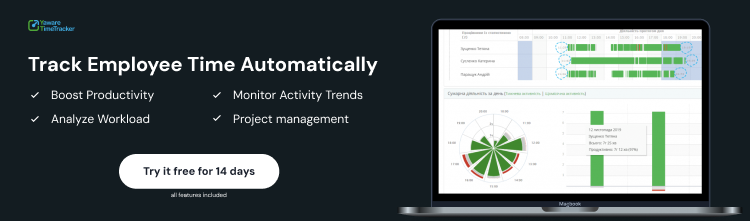
Yaware focuses on productivity analytics, not surveillance.
Step 3: Communicate correctly
Bad message: “From Monday we install control software. It is necessary.”
Right message: explain the goal, principles, and data access.
Step 4: Start with yourself
- Show your reports to the team
- Explain what you learned
- Share process changes
What to do with the data: practical scenarios
Scenario 1: Identifying overload
Data: Andriy works 10+ hours daily.
Right response: “What blocks task completion?”
Scenario 2: Low deep work
12 minutes of focus is a signal of a process issue.
Scenario 3: Workload imbalance
Ask questions to the system, not to people.
Common mistakes
- Focusing on hours instead of results
- Public comparisons
- Ignoring context
- Implementation without explanation
Conclusion: monitoring as a tool of trust, not control
- The manager sees the facts
- The employee has objective data
- Problems are detected early
- Decisions are data-driven
Key principles: transparency, aggregation, focus on processes, support, mutual benefit.
“The company has grown, and I want to see again how my business works.”
Ready to build a healthy monitoring system?
Try Yaware free for 14 days.
FAQ
Is computer monitoring of employees legal?
In Ukraine — yes, provided employees are notified.
How to explain to the team that it is not “spying”?
Start with the problem, provide access to data, and show your own statistics.